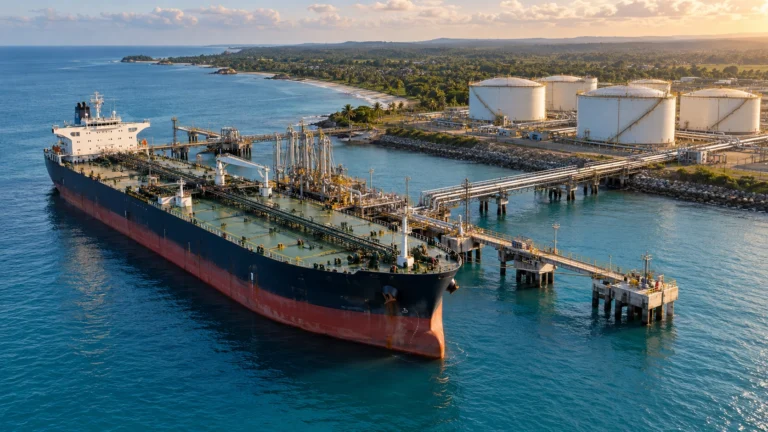
The partnership with Vitol could expand Tanzania’s coastal gateway into a centre for fuel storage and trade, as Uganda prepares for crude exports and regional refinery competition intensifies.
Tanga’s energy ambitions extend well beyond loading oil onto tankers. Tanzania and Uganda are seeking to turn the Indian Ocean port into a regional petroleum hub, connecting crude exports with storage, distribution and industrial development.
On 6 August 2026, the Uganda National Oil Company (UNOC), Tanzania Petroleum Development Corporation (TPDC) and Vitol Bahrain E.C. signed a memorandum of understanding to develop the Tanga Regional Energy Hub. Presidents Samia Suluhu Hassan and Yoweri Museveni witnessed the agreement in Dar es Salaam, reinforcing a partnership built around the East African Crude Oil Pipeline (EACOP).
Can this expanding corridor deliver reliable fuel supplies and lasting industrial growth? Its prospects depend on turning coordinated infrastructure plans into commercially viable projects with benefits that reach businesses and communities.
Quick Insights
- UNOC, TPDC and Vitol Bahrain plan to develop Tanga’s petroleum storage, logistics, trading and processing capabilities.
- EACOP reported 92.7% overall completion at the end of 2026.
- UNOC’s September announcement anticipated initial crude exports in early 2027.
- Uganda’s BRICS partnership and EACOP’s international shareholders connect the corridor to wider emerging-market and Western investment networks.
Key Developments: Prepare Tanga for Uganda’s Oil
The 1,443-kilometre EACOP will link western Uganda’s oil developments to Tanzania’s coast. The pipeline company reported 92.7% completion during a ministerial visit on 31 August 2026, bringing the export route closer to operation. Construction progress, however, still has to translate into successful testing and commissioning.
The export timetable has also evolved. In September, UNOC announced that its newly branded Pearl Sweet crude would be available for export from early 2027. The announcement put anticipated combined production from the Tilenga and Kingfisher developments at up to 230,000 barrels per day. Production startup and the first export cargo remain separate milestones, dependent on the readiness of the entire system.
The proposed hub would broaden Tanga’s role through additional petroleum infrastructure and services. Uganda’s presidency said studies for a refined-products pipeline and storage terminal were expected to be completed during 2026. These plans could connect coastal facilities more closely with inland markets, although the memorandum itself does not demonstrate that every component has secured financing or reached a construction decision.
Political Outlook: Turn Bilateral Cooperation into Regional Capacity
For Tanzania, the hub offers a route to greater influence over regional energy logistics. For landlocked Uganda, dependable access to the coast is central to converting oil production into export earnings. Their shared infrastructure therefore creates strong incentives to coordinate transit arrangements, operating standards and investment decisions.
The same interdependence creates vulnerabilities. A disruption along the corridor could affect producers, transport operators and public revenues in both countries. Clear responsibilities for maintenance, emergency response and dispute resolution would help determine whether deeper integration improves resilience.
Community outcomes will also shape the project’s credibility. Human Rights Watch’s 2023 investigation documented compensation delays and livelihood losses associated with land acquisition for Uganda’s oil developments. TotalEnergies says it applies international environmental and social standards and operates livelihood-restoration and biodiversity programmes. These positions make independently verifiable outcomes—adequate compensation, restored incomes and effective environmental protection—important measures of delivery.
Economic Outlook: Companies Position for New Trade Flows
Vitol is expanding its role across Uganda’s petroleum business. Alongside its existing fuel-supply relationship with UNOC, it has been appointed to market the crude allocated to the Ugandan government and UNOC. Participation in the Tanga hub could connect those trading activities with additional storage and logistics capacity. Commercial returns would depend on throughput, infrastructure costs and the terms governing access to facilities.
TotalEnergies, which operates Tilenga, and CNOOC, which operates Kingfisher, have a direct interest in bringing the export chain into reliable service. Their production investments depend on functioning transport and loading infrastructure. Further delays could defer sales and increase the cost of carrying those investments, while dependable operations would improve access to international buyers.
For UNOC and TPDC, the opportunity extends to earning income from infrastructure and services around petroleum production. Engineering contractors, equipment suppliers, maintenance businesses and freight operators could gain work as facilities develop. Manufacturers and agricultural distributors could also benefit if more reliable supply reduces interruptions and transport costs.
Those gains are conditional. Additional storage can improve supply resilience, but reducing dependence on imported petrol and diesel requires operating refineries and competitive distribution. Retail prices would still reflect international oil markets, exchange rates, taxes and commercial margins. Overbuilding facilities before demand and supply contracts are established could leave investors with underused capacity.
BRICS–G7 Comparison: Investment Crosses Political Divides
Uganda became a BRICS partner country on 1 January 2025, placing its energy ambitions within a broader effort to expand cooperation with emerging economies. The Tanga agreement itself is a partnership between the two national oil companies and Vitol.
EACOP’s ownership illustrates the corridor’s international character: France’s TotalEnergies holds 62%, China’s CNOOC 8%, and UNOC and TPDC 15% each. Companies from a G7 economy and a BRICS economy therefore share exposure to the same infrastructure.
This suggests a pragmatic investment pattern in which East African governments work across geopolitical groupings to obtain capital, expertise and market access. The commercial partnerships do not, by themselves, establish institutional sponsorship by BRICS or the G7.
Regional Spotlight: Kenya’s Refinery Changes the Competitive Landscape
Regional refinery plans have moved beyond the earlier discussion of a Dangote facility at Tanga. On 30 September 2026, Dangote Group held a groundbreaking ceremony for a planned $16 billion refinery at Lamu in Kenya, with completion targeted for 2030.
Honeywell Technologies separately confirmed its selection to supply technology, engineering and equipment for the planned 700,000-barrel-per-day facility.
Uganda also continues to promote its proposed 60,000-barrel-per-day Hoima refinery. Government officials describe it as complementary to the Tanga hub.
Commercially, these developments could create opportunities for regional crude processing and fuel distribution, while also competing for customers, financing and transport capacity. Tanga’s prospects will consequently depend on how its services connect with neighbouring projects and whether cross-border cooperation can prevent costly duplication.
What’s Next?
The next tests are EACOP commissioning, the start of commercial exports and the conversion of the Tanga memorandum into defined, financed projects. Published investment decisions, operating arrangements and supply commitments would provide firmer evidence of the hub’s eventual scale.
Over the longer term, project economics will also depend on how fuel demand develops as transport electrification and energy-efficiency measures advance. A phased expansion could limit exposure to uncertain demand while allowing storage, trading and distribution services to grow alongside demonstrated regional needs.