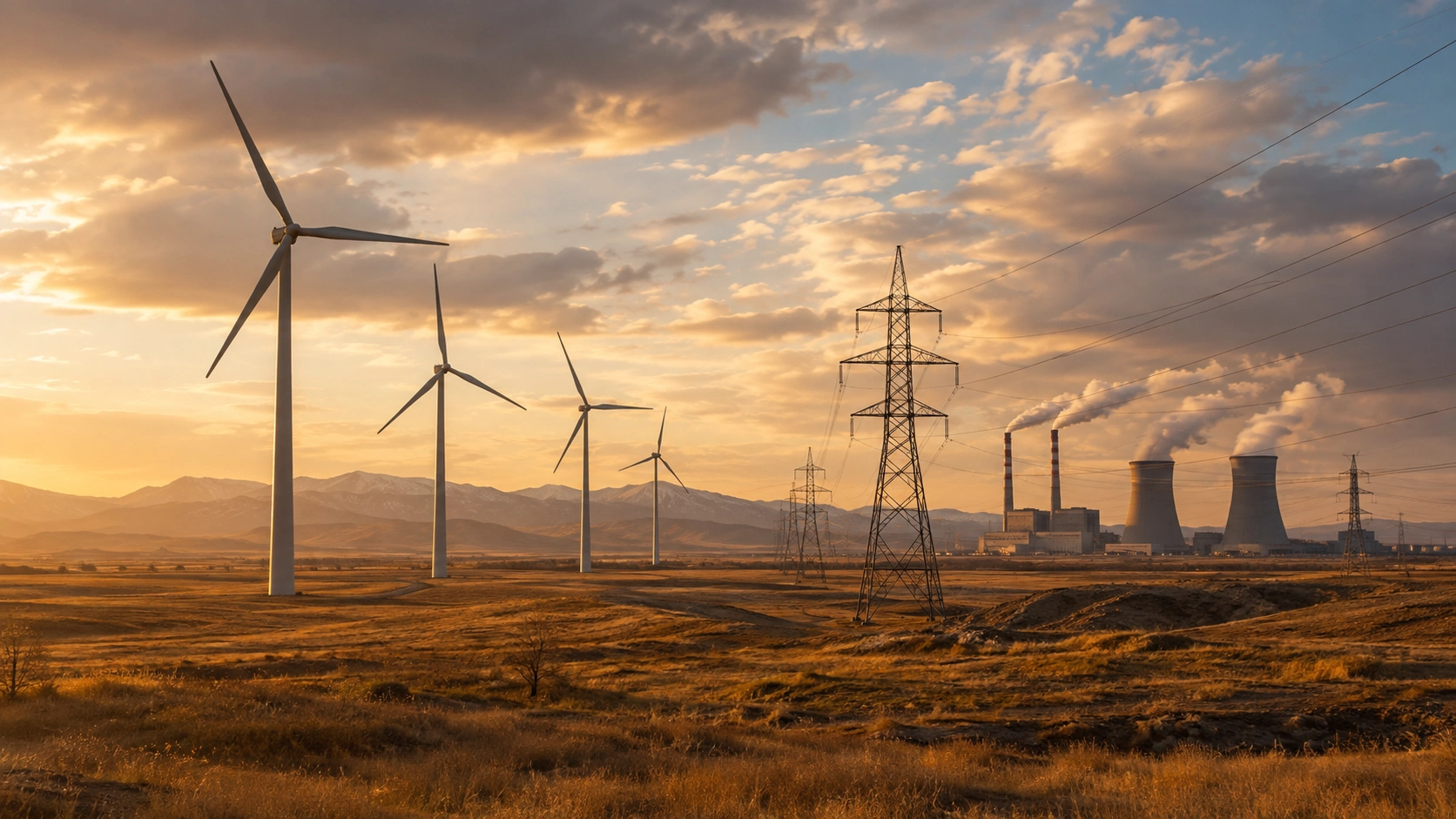
The $1.4 billion Zhambyl wind farm reveals how high borrowing costs, protected power contracts and multinational financing are reshaping Kazakhstan’s electricity market—and raising difficult questions about who bears the long-term risks.
Quick Insights
- The 1 GW Zhambyl wind project combines 140 turbines with a 300 MW/600 MWh battery system and extensive new transmission infrastructure. Masdar and W Solar each hold 40 %, while Qazaq Green Power owns 18% and the Kazakhstan Investment Development Fund holds 2 %.
- Kazakhstan’s flagship renewable projects increasingly pair foreign majority ownership with minority stakes held by state-linked Kazakh companies. TotalEnergies 1 GW Mirny project follows a similar structure, with TotalEnergies owning 60 % and Samruk-Energy and KazMunayGas holding 20 % each.
- Domestic financing remains expensive, although the National Bank reduced its base rate from 17 % to 16.75 % on July 24, 2026. The rate is therefore no longer exactly 17 %, as earlier accounts of the project claimed.
- The claim that Kazakhstan’s banks lend more than twice as much to households as to the real economy requires qualification. Under the National Bank’s expanded definition, household loans stood at KZT 27.5 trillion and business loans at KZT 24.8 trillion on June 1, 2026 – a narrower gap than some banking statistics suggest.
- Dollar-linked power contracts improve project bankability but do not remove currency risk. Instead, they transfer much of that exposure from investors to the Kazakh off-taker, electricity consumers or the wider public-sector balance sheet.
Foreign Investors Move as Kazakhstan’s Power Gap Widens
Can a country modernize its electricity system without surrendering most of the financial upside to external investors? Kazakhstan is about to test that proposition on an unprecedented scale.
On June 29, 2026, Abu Dhabi-based Masdar formally broke ground on a 1 GW wind farm in Kazakhstan’s southern Zhambyl Region. The $1.4 billion development will include a 300 MW battery capable of storing 600 MWh of electricity, making it one of Central Asia’s largest integrated wind-and-storage projects. Masdar estimates that the plant could supply the equivalent of approximately 880,000 homes and avoid around 2.5 million tonnes of carbon dioxide emissions annually.
The ownership structure is as revealing as the project’s size. Masdar and W Solar each hold 40 %, giving the two UAE-linked companies a combined 80 % interest. Qazaq Green Power, which belongs to the Samruk-Kazyna group, holds 18%, while the Kazakhstan Investment Development Fund owns the remaining 2 %. The arrangement allows Kazakhstan to retain a direct financial interest while leaving development leadership and most shareholder exposure with foreign sponsors.
The infrastructure extends far beyond wind turbines. Asian Infrastructure Investment Bank disclosures describe 140 wind-turbine generators, a battery complex and two 220-kilovolt transmission connections to the Zhambyl and Kentau substations. Masdar has said the broader project will require more than 400 kilometres of overhead lines, while AIIB documentation refers to approximately 300 kilometres within the bank’s defined project scope. The difference appears to reflect variations in what each organization includes in the transmission package rather than a fundamental disagreement about the development.
Regional spotlight: Zhambyl. The location is strategically important because southern Kazakhstan is one of the country’s fastest-growing electricity-consuming areas. National grid operator KEGOC recorded a 12.7% increase in Zhambyl Region’s electricity consumption in 2025, while demand across the entire Southern Zone rose by 8%. The new wind farm is therefore being built close to a rapidly expanding load centre rather than merely to satisfy national climate targets.
Yet Zhambyl is not an isolated investment. TotalEnergies reached a final investment decision in April 2026 on the separate $1.2 billion Mirny development, also comprising 1 GW of wind generation and 600 MWh of storage. TotalEnergies owns 60%, with Samruk-Energy and KazMunayGas taking 20 % each. Approximately 75% of Mirny’s cost is being externally financed by a consortium that includes the European Bank for Reconstruction and Development, Proparco, Germany’s DEG, Société Générale, Standard Chartered, Qatar National Bank, China Construction Bank and the Development Bank of Kazakhstan.
Saudi Arabia’s ACWA Power has also been part of Kazakhstan’s renewable-energy pipeline. Samruk-Energy and ACWA Power signed a memorandum in 2022 envisaging wind farms with a combined capacity of 1 GW. Publicly available information, however, supports describing this as a planned partnership rather than a project at the same construction or financing stage as Zhambyl or Mirny.
The wider urgency is difficult to overstate. Kazakhstan consumed 124.6 TWh of electricity in 2025, up 3.8 % from the previous year, and domestic production fell short of consumption by almost 1.5 TWh. The deficit was covered through net supplies from Russia, even as Kazakhstan continued exchanging balancing electricity with both Russia and Central Asian neighbours.
Government projections are more concerning. An official capacity plan estimated that Kazakhstan could require 28.2 GW of available capacity by 2030 but have only around 22 GW even after already planned additions, leaving a gap exceeding 6 GW under the assumptions used in that forecast. A more recent S&P Global assessment cited an official projected deficit of 3.1 GW for 2026, demonstrating that estimates vary with reserve margins, commissioning schedules and the definition of available capacity. Both calculations point in the same direction: new generation is required faster than Kazakhstan’s existing investment system has historically delivered it.
Why Domestic Capital Struggles to Compete
At first sight, electricity generation should be an attractive proposition for Kazakhstan’s business groups. Demand is growing, supply is constrained and the government is offering long-term procurement arrangements. Why, then, are domestic private investors not leading the country’s largest greenfield projects?
The first answer is the cost and duration of capital. Large wind farms, thermal stations, batteries and transmission facilities require long construction periods and revenues earned over decades. Their economics depend not simply on whether electricity demand exists but on whether developers can borrow at rates compatible with the project’s expected cash flow.
Kazakhstan’s monetary conditions make that difficult. On July 24, 2026, the National Bank cut its base rate by 25 basis points to 16.75 %, citing nine consecutive months of declining annual inflation. Nevertheless, annual inflation was still 10.3% in June, household inflation expectations stood at 13.4 %, and the central bank described monetary conditions as moderately tight. A 16.75 % policy rate remains far above the financing costs generally associated with internationally financed utility infrastructure.
The original argument that business loans “routinely exceed 20 %” is directionally plausible but should not be treated as a universal published rate for every project. Available market data placed Kazakhstan’s average bank lending rate at roughly 19.6 % in May 2026; individual corporate facilities can differ substantially according to maturity, collateral, currency and state support. The more defensible conclusion is that commercial tenge financing costs are around 20 % and often incompatible with infrastructure whose returns accumulate over 15, 20 or 25 years.
Foreign sponsors operate with a different financial toolkit. Masdar can draw on a shareholder base that includes TAQA, Mubadala and ADNOC, all major Abu Dhabi institutions with long investment horizons and access to international capital. W Solar is part of Alpha Dhabi Holding’s investment portfolio. Their strategic objective is not limited to earning an immediate yield in Kazakhstan; Zhambyl also expands their geographic presence, renewable-development pipeline and positioning in Central Asian infrastructure.
TotalEnergies has similarly assembled a multinational debt package for Mirny rather than relying primarily on local commercial credit. Its lenders span European development institutions, Gulf and Chinese banks and Kazakhstan’s state development bank. The project will sell electricity under a 25-year power purchase agreement and is expected to reach full capacity in 2029, allowing long-term debt to be matched more closely with predictable long-term revenue.
Kazakhstan’s banking data support the diagnosis of a structural financing constraint, but not every version of the argument. Under the National Bank’s expanded lending definition, total credit to the economy reached KZT 52.3 trillion on June 1, 2026. Businesses accounted for KZT 24.8 trillion, or 47.5 %, while households accounted for KZT 27.5 trillion, or 52.5%. Household credit was larger, but not twice as large as business credit.
The much wider imbalance sometimes cited—around $60 billion for households against approximately $29 billion for private non-financial enterprises—results from combining narrower institutional or borrower categories. It should not be presented as a complete comparison between households and the entire real economy. The broader data nevertheless reveal that nearly half of Kazakhstan’s expanded loan stock is directed to households, despite the country’s enormous need for industrial, power and grid investment.
Nor is Kazakhstan’s private sector entirely absent from electricity. The International Energy Agency describes the country’s generation industry as being operated mainly by private enterprises, and KEGOC data identify significant production by companies connected to Kazakhmys, Kazchrome, Qarmet and other industrial groups. The more precise problem is that domestic private capital has played a limited leading role in the newest, largest, project-financed utility developments—especially 1 GW renewable projects that require international-scale debt, imported technology and sophisticated risk allocation.
This distinction matters. Companies such as Kazakhmys, Eurasian Resources Group and Qarmet already generate power, often for industrial operations or through established thermal assets. Their experience proves that local corporate ownership is possible. What remains difficult is financing a new multi-billion-dollar plant whose revenues depend on regulated market arrangements while its equipment, debt service and construction costs may be linked to foreign currencies.
Dollar-Linked Contracts Reallocate the Risk
Foreign investors are not entering Kazakhstan simply because they possess cheaper money. They are also entering projects whose contractual structures have been designed to satisfy international lenders.
For Zhambyl, Qazaq Wind Power signed an investment agreement with the Kazakh government and a power purchase agreement with the Financial Settlement Center for Renewable Energy Sources Support. The project company will sell its electricity exclusively to the settlement centre. Crucially, the tariff is denominated in US dollars but paid in tenge at the exchange rate applicable on the payment date.
That provision protects project revenues against a depreciation of the tenge. If the Kazakh currency weakens, the amount paid in tenge rises so that the dollar-denominated value of the tariff is maintained. This reduces one of the biggest risks facing a project whose turbines, batteries, engineering services and debt may be priced partly in foreign currency.
However, currency risk has not disappeared. Economically, it has been shifted toward the buyer and ultimately toward the actors financing the buyer’s obligations. Depending on future tariff policy and the Financial Settlement Center’s balance sheet, the additional tenge cost could be passed to wholesale purchasers, industrial users, households or public-sector support mechanisms. The exact distribution will depend on regulation, but the exchange-rate exposure no longer sits primarily with the foreign shareholder. This is an inference from the dollar-denominated tariff and Kazakhstan’s regulated electricity-market structure.
Kazakhstan did not create currency indexation solely for foreign companies. The EBRD says reforms to the renewable-energy framework have included longer PPAs, currency and consumer-price indexation, reverse auctions and measures to improve the creditworthiness of the Financial Settlement Center. The bank reports financing projects involving both domestic and international sponsors. It would therefore be inaccurate to conclude that local investors are formally excluded from every bankable renewable-energy mechanism.
Nevertheless, a material difference remains between participating in a standard renewable auction and negotiating a strategic investment agreement for a 1 GW project. Large foreign-led developments can bring diplomatic backing, development-bank participation, experienced sponsors and access to sovereign or quasi-sovereign counterparties. A domestic independent power producer without those relationships may face the same construction and regulatory risks but lack equivalent access to low-cost debt or bespoke contractual negotiations.
Claims that all foreign investors receive explicit sovereign guarantees should also be treated cautiously. AIIB classifies its contemplated financing for Zhambyl as nonsovereign. The documents confirm a government investment agreement, an exclusive PPA and dollar-linked pricing, but they do not establish that Kazakhstan has issued an unrestricted sovereign guarantee covering every shareholder’s invested capital. The contractual protection is substantial, yet it should not be overstated.
The same contracts that make construction possible can therefore create future political tension. When tariffs rise because of currency depreciation, households may see only higher utility bills, not the financing logic behind them. Policymakers must then choose between allowing full cost recovery, subsidizing consumers or forcing project counterparties to absorb losses – each of which carries consequences for inflation, public finances or investor confidence.
Environmental obligations add another layer of risk. AIIB has classified Zhambyl as a Category A project because of biodiversity sensitivities, bird and bat collision risks, proximity to cultural-heritage sites, land restrictions and the complexity of its infrastructure. Planned mitigation includes turbine siting controls, shutdown-on-demand procedures for priority bird species, bird diverters on transmission lines and habitat restoration. No physical displacement is expected, but some grazing and land users may experience access restrictions or minor livelihood effects.
For Masdar and W Solar, effective implementation will be essential to avoid delays and reputational damage. For Qazaq Green Power and KIDF, the project provides exposure to utility-scale batteries and international project management, but it also makes their minority investment dependent on the operational and environmental performance of the foreign-led consortium.
Political Outlook Links BRICS to Multi-Vector Diplomacy
Zhambyl is more than an energy investment. It is an instrument of Kazakhstan’s long-standing multi-vector foreign policy, through which Astana seeks commercial and diplomatic relationships with Russia, China, Europe, the Gulf states and other emerging powers without becoming excessively dependent on any single partner.
The UAE dimension has become particularly important. Masdar’s first Kazakh project connects Kazakhstan to Abu Dhabi’s state-backed investment ecosystem, while the associated roadmap for round-the-clock renewable power could supply up to 200 MW of initial baseload electricity for data centres and artificial-intelligence infrastructure. The partnership therefore joins energy security with Kazakhstan’s ambition to attract digital industries.
Kazakhstan has been a BRICS partner country since January 1, 2025, while the UAE is a full BRICS member. Under India’s 2026 chairmanship, BRICS has emphasized resilience, innovation, cooperation and sustainability. The Zhambyl investment fits that agenda by linking capital from a BRICS member with renewable infrastructure in a partner country, although the development is a bilateral commercial project rather than a formal BRICS institution-led programme.
At the same time, Kazakhstan’s power strategy cannot be reduced to a BRICS alignment. France’s TotalEnergies—a company headquartered in a G7 economy — is leading Mirny, and its lender group includes European, British, Gulf, Chinese and Kazakh institutions. This blended financing architecture demonstrates that Kazakhstan is drawing capital across geopolitical blocs rather than replacing Western investors with BRICS investors.
The contrast with the abandoned Inter RAO arrangement reinforces that conclusion. Kazakhstan and Russia had planned three combined heat-and-power projects in Kokshetau, Semey and Ust-Kamenogorsk, with combined capacity of around 1 GW and an estimated value of $2.2 billion. The Russian contractor was expected to secure concessional export financing but was unable to do so, leading Kazakhstan to pursue alternative implementation structures.
By 2026, Samruk-Energy had awarded engineering, procurement and construction roles for the projects to a Kazakh-Singaporean consortium, although public reports did not identify the consortium members. Officials had also discussed possible participation by Chinese partners. The episode shows that Kazakhstan is willing to switch counterparties quickly when financing fails, but it also confirms that access to external technology and capital remains decisive even for conventional thermal generation.
The political opportunity is diversification. UAE, French, Chinese, Singaporean, Russian and multilateral involvement reduces the danger that one foreign government or lender can dominate Kazakhstan’s entire electricity programme. Competition among partners may improve financing terms and allow Kazakhstan to select different technologies for different regions.
The political risk is fragmented dependency. A grid assembled through multiple bilateral agreements may leave Kazakhstan managing different lender requirements, tariff formulas, technical standards and diplomatic sensitivities. Disputes in one part of the relationship can also spill into another. TotalEnergies, for example, proceeded with Mirny while contesting a $4.6 billion environmental penalty and a separate multibillion-dollar cost dispute connected to the Kashagan oilfield; Shell, another Kashagan participant, had paused further Kazakh investment amid those disputes.
BRICS versus G7
The most important comparison is therefore not which grouping “wins” Kazakhstan’s energy market. BRICS-linked capital—most visibly from the UAE and China—offers state-supported finance, large infrastructure contractors and growing clean-energy expertise. G7-linked companies and institutions bring global project-development experience, technology, environmental standards and deep capital markets. Kazakhstan is combining both. Its bargaining power will depend on maintaining that competition and ensuring that contracts create local capabilities rather than merely importing completed assets.
Economic Outlook Identifies Winners and Pressure Points
Masdar and W Solar are among the clearest corporate beneficiaries. Zhambyl gives both companies a flagship Central Asian platform, long-term contracted revenue and an opportunity to extend their involvement into round-the-clock renewable systems for data centres. Masdar has described the project as part of its global expansion, while Alpha Dhabi has presented W Solar’s participation as evidence that climate infrastructure is becoming a core international investment strategy.
TotalEnergies and its battery subsidiary Saft also stand to gain. Mirny expands TotalEnergies renewable portfolio while giving Saft a high-profile 600 MWh storage deployment. The project is expected to generate about 100 TWh over 25 years, and its multinational financing structure limits the amount of capital TotalEnergies must fund directly. However, the company remains exposed to construction risk, Kazakhstan’s regulatory environment and the potential for broader investment disputes to affect government relations.
Kazakhstan’s state-linked companies gain strategic exposure without carrying the majority of project equity. Qazaq Green Power and KIDF participate in Zhambyl, while Samruk-Energy and KazMunayGas together own 40% of Mirny. These stakes can retain part of the dividend stream domestically, provide access to operating expertise and strengthen the state’s oversight of strategically important assets. The trade-off is that foreign sponsors retain control or majority influence and therefore capture a larger portion of long-term shareholder returns.
KEGOC and regional network companies face both an opportunity and a burden. New wind and battery projects can reduce energy deficits and improve flexibility, but connecting gigawatt-scale variable generation requires new substations, transmission corridors, balancing systems and grid-management technology. Kazakhstan’s power sector entered 2025 with 25.3 GW of installed capacity but only around 21 GW considered available, while more than 78% of installed capacity was thermal. Integrating several new 1 GW wind projects will therefore require modernization of an aging system rather than the simple addition of turbines.
The investment requirement is enormous. S&P Global estimated that power-sector investment reached a record $4.6 billion in 2025, up 56.5 % from 2024, but calculated that generation, heat, distribution and transmission modernization programmes together could require well over $50 billion. Approximately two-thirds of the 2025 investment total was still associated with assets not yet placed into operation, underlining the lag between capital spending and usable capacity.
Domestic construction, engineering and equipment companies could benefit through subcontracting, civil works, transport, maintenance and transmission development. Yet the scale of the local value added will depend on procurement rules, technology-transfer provisions and the availability of qualified suppliers. If turbines, batteries, control systems and specialist engineering are imported with limited domestic production, Kazakhstan may gain electricity capacity without building an equally strong local clean-energy manufacturing sector.
Energy-intensive industries stand to gain if new capacity improves reliability. Mining, metallurgy, phosphate production, data centres and processing businesses require stable power, and KEGOC data show that companies such as Kazchrome, Kazphosphate, Qarmet, Kazakhmys and Kazzinc remain major participants in electricity consumption or generation. Reduced shortages could lower outage risks and support industrial expansion, particularly in southern and western regions where consumption has been rising rapidly.
Consumers face a more complicated outcome. Additional generation can reduce dependence on emergency imports and lower the economic costs of shortages. However, dollar-indexed PPAs, major transmission expenditure and modernization of regulated thermal and heating assets will all require revenue. If the tenge depreciates or project costs rise, tariffs may have to increase unless the state absorbs part of the burden. Kazakhstan’s central bank already identifies housing and utility tariffs as an important concern shaping household inflation expectations.
The concern that profits will “flow abroad for decades” is partly valid but incomplete. Majority-foreign ownership means that a substantial share of dividends and international debt service can leave Kazakhstan. Yet domestic minority shareholders will also receive returns, local workers and contractors may earn income, the state will collect taxes, and completed transmission assets are expected to be transferred to the government after the scheduled commercial-operation date under the Zhambyl structure. The final national benefit will depend less on the nationality of the investor alone than on financing costs, local procurement, tax treatment, tariff design and technology transfer.
The central policy challenge is therefore not to eliminate foreign investment. Kazakhstan needs external capital to close an immediate capacity gap that domestic finance cannot currently cover on comparable terms. The challenge is to use foreign capital without permanently preventing domestic pension funds, insurers, banks and industrial companies from developing their own long-duration infrastructure portfolios.
What’s Next for Kazakhstan’s Power Market?
The next major test will be execution. Zhambyl and Mirny are both expected to reach full or commercial operation around 2029. Delays in turbines, batteries, transmission lines or permitting would leave Kazakhstan exposed to continued imports and capacity shortages during the second half of the decade.
Attention will also turn to whether Kazakhstan’s Financial Settlement Center can honour multiple large, indexed PPAs without creating unsustainable pressure on wholesale tariffs. The EBRD’s work to improve the centre’s creditworthiness has helped attract investment, but each additional dollar-linked contract increases the importance of transparent liabilities, stress testing and credible tariff-adjustment mechanisms.
A gradual decline in inflation and interest rates could eventually allow more domestic participation, but a small reduction in the base rate will not close the financing gap. For local investors to compete, Kazakhstan may need longer-tenor tenge instruments, infrastructure bonds, pension-fund participation, partial credit guarantees and development-bank structures that do not depend entirely on foreign-currency borrowing.
Policymakers may also seek stronger local-content and technology-transfer provisions. Battery maintenance, grid software, electrical engineering and component assembly offer more realistic near-term opportunities than attempting to manufacture complete wind turbines immediately. Partnerships involving Masdar, TotalEnergies, Saft, Samruk-Energy and KazMunayGas could become training platforms—provided local capability development is incorporated into procurement and operating agreements.
Finally, Kazakhstan’s growing BRICS partnership could open additional channels through institutions and companies connected to the UAE, China and India. Yet the evidence from Zhambyl and Mirny suggests that the country’s most effective strategy will remain multi-vector: combining BRICS capital, G7 technology, multilateral development finance and domestic state participation instead of relying on a single geopolitical bloc.
The emerging model can solve Kazakhstan’s immediate electricity shortage. Whether it also creates a competitive domestic infrastructure-investment market will depend on what happens after the groundbreaking ceremonies – when exchange rates move, tariffs are reviewed, construction bills arrive and the first dividends are distributed.