China Launches Arctic Shipping Route, 18 Days to Europe
Beijing opens a seasonal “Arctic Express” shipping line linking China to Northern Europe in just 18 days—less than half the usual transit time. The bold move aims to rewrite global trade routes amid climate change, geopolitical shifts, and environmental concerns.
Quick Insights
- Faster Arctic Passage: China’s first regular container service via the Arctic slashes shipping time from Asia to Europe to about 18 days, compared to 40+ days via Suez. The inaugural voyage departed Ningbo on Sept 20 and will reach Felixstowe, UK by early October, halving transit times and setting a new record.
- Climate-Opened Corridor: Rapid Arctic warming (four times the global average) has melted sea ice and created seasonal shipping windows. China’s ice-class vessel Istanbul Bridge (4,890 TEU) is navigating Russia’s Northern Sea Route (NSR) in late summer, aided by a new real-time satellite ice monitoring system for safety. For now the route is open only July–October, but Beijing’s long-term goal is year-round navigation.
- Geopolitical Signal: Until now, 95% of NSR transit cargo was China-Russia trade. This new “China-Europe Arctic Express” pointedly bypasses Russian ports, demonstrating Beijing’s capacity to open independent trade corridors to Europe. It sends a strategic message: China can diversify routes beyond traditional chokepoints (Suez, Malacca) without entanglement in the Ukraine war context.
- Environmental Concerns: Scientists and NGOs warn that more Arctic shipping means higher risks of oil spills, hazardous black carbon emissions, and harm to whales and polar ecosystems. The IMO’s Polar Code (in force since 2017) mandates strict safety and pollution standards for polar waters, making Arctic operations costlier. Green groups urge even tougher rules—ice-strengthened ships, cleaner fuels (a ban on heavy fuel oil took effect in 2024), noise reduction, and thorough impact assessments—before Arctic waters become a busy ocean highway.
- Economic Trade-Offs: The Arctic shortcut is targeted at time-sensitive cargo like cross-border e-commerce parcels and high-value goods (e.g. EV batteries), offering faster delivery at a premium. Shipping rates on this route reportedly sit between pricey rail freight and conventional sea freight. Chinese exporters (and European importers) stand to benefit from quicker inventory turnover and holiday-season restocking. Yet higher insurance, icebreaker fees, and compliance costs mean per-container expenses are still higher than the Suez route, limiting the Arctic line to niche use for now. Western shipping giants like MSC, Maersk, and CMA CGM have even pledged to avoid the NSR entirely, citing environmental and safety concerns, highlighting a split in industry strategy.
Opening the Ice Silk Road – A New Era of Shipping?
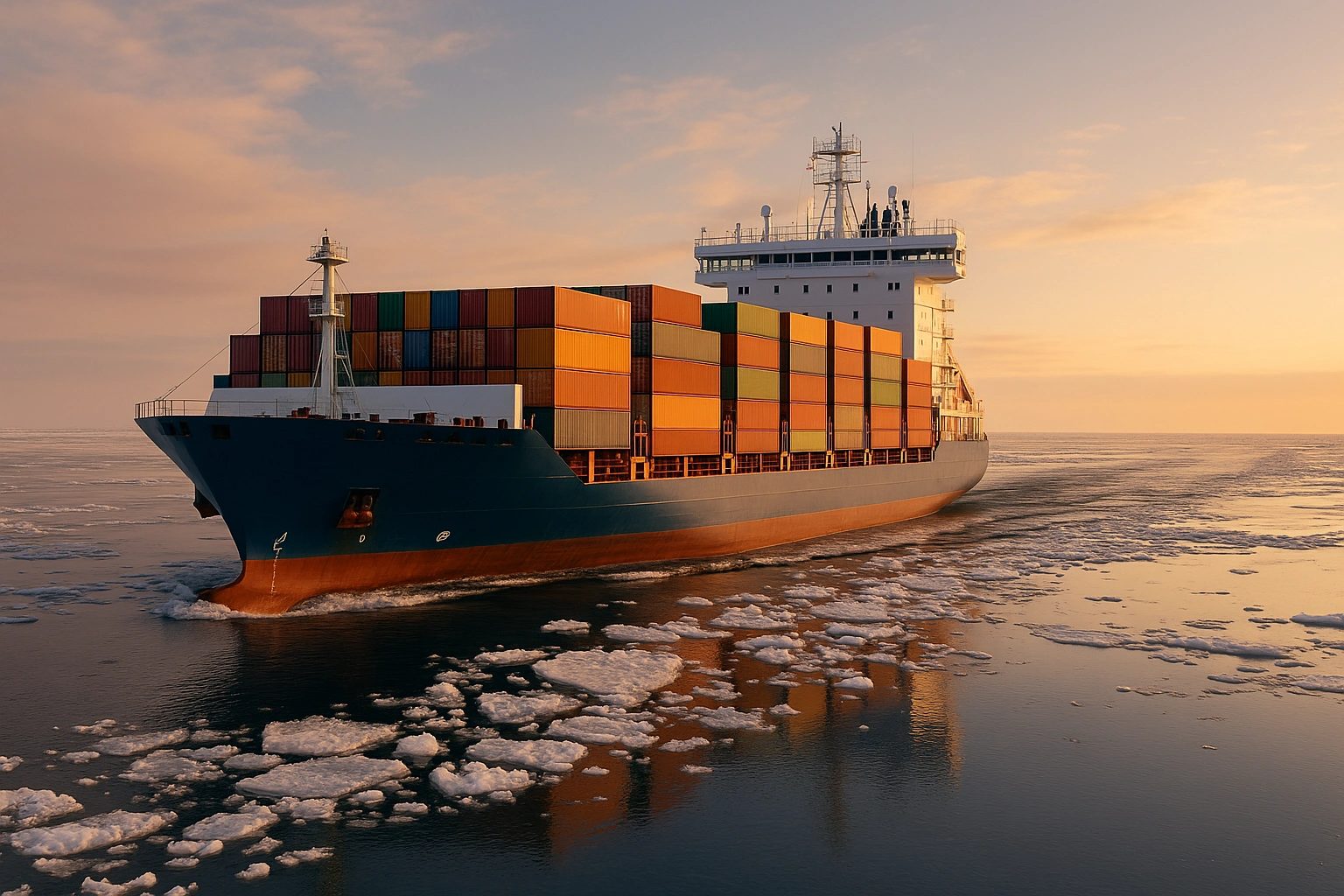
Can a melting Arctic truly rewrite the map of global trade? This month, China is betting that it can. In a bold first, a Chinese shipping company has launched a regular container service via the Arctic Ocean, not as a one-off experiment but as a scheduled line. Dubbed the China-Europe Arctic Express, the route connects major ports in China (Qingdao, Shanghai, Ningbo) with key Northern European ports (Felixstowe in the UK, Rotterdam, Hamburg, and Gdansk). The Istanbul Bridge, an ice-reinforced vessel carrying nearly 5,000 TEU, set sail from Ningbo on September 20. In just 18 days, it will arrive in Britain’s Felixstowe – a journey that would normally take 40 to 50 days via the Suez Canal. This dramatic time savings – less than half the usual transit – could revolutionize logistics between Asia and Europe
The Arctic shortcut is possible thanks to climate change opening previously ice-choked waters. Over the past 40 years, the Arctic has warmed about four times faster than the global average. As a result, summer sea ice has retreated, creating a navigable window each year along Russia’s Northern Sea Route (NSR), which hugs the Siberian coast from the Bering Strait to the Barents Sea. The NSR offers the most direct path between China and Northern Europe – up to 40% shorter by distance than the Suez route in some cases. In fact, the new Arctic express aims to be 40% faster than even China’s recent fast services via Suez. The shorter voyage not only saves time but also, according to Chinese port officials, could cut fuel consumption and carbon emissions roughly in half for that trip since ships spend far fewer days at sea.
Yet, this is no easy voyage. Even in summer, the Arctic can be perilous – unpredictable floating ice, thick fogs, and violent storms pose constant threats. The Istanbul Bridge is relatively small by global container standards (about one-quarter the capacity of mega-ships that ply Suez), but it is purpose-built with an ice-strengthened hull. To further mitigate risks, China’s maritime authorities rolled out a real-time ice monitoring system for this project. Using satellites and oceanographic data, it maps navigable channels and alerts ships to ice floes or blockages in real time. This high-tech support network aims to make Arctic transits more predictable and safer, a critical factor after incidents like a Chinese vessel’s lost anchor reportedly damaging an undersea pipeline last year. For now, the service will operate only in late summer and early autumn when ice coverage is minimal. But this maiden run is a proof of concept – if all goes well, China plans to deploy more advanced ice-class ships to gradually extend operations into harsher seasons, ultimately pushing toward a year-round Arctic corridor.
Geopolitical Currents Beneath the Ice
While the technical feat is impressive, the bigger story is geopolitical. By opening an independent route to Europe via the Arctic, China is flexing its strategic autonomy. Traditionally, Asia-Europe trade relies on routes controlled or easily disrupted by others – the Suez Canal (in Egypt), the Strait of Malacca, the Red Sea, or even rail lines through Russia. The new Arctic express, in contrast, lies largely outside those choke points. Notably, the service bypasses Russian ports entirely, even though it sails through Russia’s exclusive economic zone in the Arctic. Until now, nearly all Arctic voyages by Chinese ships were in partnership with Russia, often connecting a Chinese port to a Russian Arctic port. In 2024, for example, there were 17 container transits on the NSR, mostly China-Russia shipments run by another Chinese firm (NewNew Shipping). In fact, 95% of all NSR transit cargo last year traveled between China and Russia. By directly linking China to Western Europe, Beijing is signaling that it can open new corridors on its own terms – an implicit message of resilience amid great-power rivalries.
However, Beijing’s Arctic gambit is a delicate dance. On one hand, it aligns with China’s 2018 “Polar Silk Road” vision – an initiative to integrate Arctic routes into the Belt and Road framework for greater connectivity. Chinese analysts often portray Arctic shipping as a shared opportunity, and China has observer status at the Arctic Council to underscore its interest. On the other hand, China must navigate the sensitivities of Arctic nations. Russia, which calls the NSR its “Northern Sea Route” and views it as sovereign waters, has heavily militarized and invested in the Arctic, hoping to turn it into a major trade artery. The Kremlin derives an estimated 10–20% of its GDP from its Arctic territories (rich in oil, gas, and minerals), and President Putin has made Arctic development a national priority. Russia has built new ports and a fleet of nuclear icebreakers to escort ships, aiming for year-round navigation and vastly higher cargo volumes in the 2030s. By launching an Arctic service that doesn’t stop in Russia, China walks a fine line: benefitting from Russia’s icebreaker-supported route while not becoming overly entangled in Russian infrastructure or sanctions risks. Indeed, reports indicate China is cautious about large investments in Russia’s Arctic projects, even as it uses the NSR for transit.
From Europe’s perspective, the Chinese Arctic express sends mixed signals. European importers welcome faster shipping for certain goods, and ports like Rotterdam, Hamburg, and Felixstowe stand to gain additional throughput. The voyage of the Istanbul Bridge is being watched closely in Northern Europe as a potential logistics game-changer. Yet European officials and environmental groups also voice concern. The Arctic route’s appeal – avoiding conflict zones (like the Suez and Red Sea, where incidents such as the Ever Given blockage or regional wars have caused disruptions) – can’t be divorced from its broader implications. If more trade shifts north, it could reduce traffic (and revenue) through the Suez Canal and alter global shipping patterns, something traditional powers will notice. Moreover, the European Union has articulated a cautious Arctic policy centered on environmental protection and sustainability. The EU and G7 nations have generally not embraced Arctic shipping; in fact, several top European shipping companies have publicly vowed not to use it. MSC, Maersk, CMA CGM, Hapag-Lloyd – all have pledged to avoid Arctic routes to safeguard the fragile ecosystem. When China’s move is contrasted with these stances, it underscores a geopolitical split in how different players balance commerce vs. climate. Europe must now weigh its climate commitments against the allure of a quicker supply chain from its largest trading partner, China.
Security is another undercurrent. The Chinese government has invested in Arctic-capable navigation technology (like the Tianjin ice monitoring center) to reduce accident risks, but any mishap in those remote, icy waters could become an international incident. NATO countries, including the US, Canada, and Norway, keep a wary eye on increased activity in the high north, fearing it could have military dimensions or infringe on Arctic sovereignty. China maintains that its aims are purely commercial and scientific, framing the Arctic express as part of a “Polar Silk Road” open to all. By demonstrating it can safely send goods through the Arctic, Beijing also bolsters its narrative of being a global maritime power with routes outside U.S. influence. This resonates with other BRICS and Global South countries looking to reduce dependence on Western-controlled chokepoints. Still, China has so far tread carefully, emphasizing cooperation. The Istanbul Bridge’s voyage is also a gesture to Europe: an offer of closer connectivity that sidesteps the fraught Russia-Ukraine war geography. In Chinese media, officials stress that the Arctic line is about trade efficiency and not intended to “militarize” or dominate the region. How Europe responds – with open arms for faster trade, or with regulatory pushback on environmental grounds – will reveal much about the evolving geopolitical equation.
Economic Outlook: Who Wins, Who Faces Headwinds?
For businesses, the allure of cutting transit time by weeks is obvious – but so are the costs and risks. The new Arctic express is targeting a premium niche of cargo that benefits from faster delivery: think high-value electronics, fresh or seasonal goods, fashion and retail inventory for holiday sales, and critical manufacturing components. Chinese e-commerce giants and manufacturers are keen participants; the inaugural sailing was fully booked by Chinese exporters, including online retailers and electronics firms, eager to get products to Europe’s market faster. By arriving in early October, the Istanbul Bridge reaches Europe just in time to stock warehouses for the year-end shopping season. Companies can reduce inventory lead times and accelerate cash cycles. In supply chain terms, this Arctic route positions itself between expensive air freight and the long slow boat via Suez – offering a new speed-vs-cost tradeoff. According to the operator, the shipping rate per container on the Arctic service is higher than normal sea freight but lower than rail or air. That pricing targets customers for whom a few weeks’ time savings justifies paying a premium – for example, fashion retailers selling fast-turnover apparel, or battery manufacturers sending time-sensitive high-tech goods. European importers of Asian goods (think consumer electronics distributors or auto parts suppliers) could also benefit from more flexibility and reliability in delivery schedules.
However, it’s not smooth sailing for everyone. Traditional shipping lines and transit hubs might see this development as a competitive threat in the long run – but many remain skeptical that Arctic routes will become mainstream soon. The Suez Canal Authority, for instance, downplays the risk, noting that Suez operates year-round and can handle far larger ships, whereas the NSR is seasonal and capacity-limited by ice. Indeed, the Arctic’s harsh economics are a built-in speed bump. Specialized ice-class ships are costly to build and operate, insurance premiums for Arctic voyages are steep (reflecting the higher danger and sparse emergency infrastructure), and strict compliance with the Polar Code environmental rules adds further expense. “What you gain in time, you lose in added costs,” as Arctic shipping expert Leonardo Parigi observed, pointing out that even a small incident (like a fuel leak) in these pristine waters can have outsized costs. For now, analysts judge that the cost-benefit of the Arctic route is roughly balanced at best – savings on fuel and time are offset by icebreaker fees, hardened ship requirements, higher crew training and hazard pay, and potential carbon fees or environmental levies. Only if volume grows and technology improves (or if alternative routes face disruption) will the Arctic option become economically competitive at scale.
Certain sectors stand to gain notably. Logistics and retail companies that thrive on just-in-time delivery may use the Arctic express as a strategic option during peak seasons. Ports in Northern Europe could see incremental volume and diversify their supply chain links – for example, the Port of Gdansk, Poland, which is included in the route, may bolster its role as a gateway for Chinese goods into the Baltic region. Likewise, British and Dutch port operators welcome any edge that brings in more business and reduces congestion elsewhere. Chinese shipbuilders and Arctic research institutes also benefit as this pilot could spur demand for more ice-capable vessels and services. Notably, Russia’s role is complicated: on one hand, Russia provides icebreaker escorts and has invested in NSR infrastructure, so more transit traffic could bring fees and justify its Arctic ambitions. On the other hand, this specific service gives Russia little direct business (since it doesn’t stop at Russian ports), and if China corners the transit trade, Russia might only collect transit tolls while China and Europe reap the trade gains.
Meanwhile, there are potential losers or challengers. Competing routes and carriers face pressure: for example, maritime shippers on the traditional Asia-Europe lanes could lose some market share of time-sensitive cargo to the Arctic service. If Arctic routing proves reliable, it might eventually siphon a portion of the volume from liners that go via Suez or even from China-Europe rail lines. The China-Europe Railway Express, a network of fast freight trains through Central Asia to Europe, currently delivers containers in around 20–25 days; SeaLegend’s Arctic ship at 18 days undercuts that speed. To respond, rail operators might need to lower rates or emphasize their all-weather reliability (trains run year-round, whereas the NSR shuts in winter). Likewise, air freight (which is much faster but far more expensive) could lose a sliver of business from clients willing to wait 2–3 weeks instead of 1–2 days if the cost is dramatically cheaper by sea. However, given the small scale of this initial Arctic venture – just one sailing in 2025, likely a handful in coming years – the impact on major industry players is marginal for now. Many shipping experts view it as a “trial run” that will stay niche until big players jump in.
Interestingly, some of the world’s largest shipping companies remain openly averse to Arctic operations, citing both environmental responsibility and operational risk. MSC, the world’s biggest container carrier, reaffirmed in 2024 that it will not send ships via the NSR, even as discussions heated up about Suez alternatives during geopolitical crises. Similarly, France’s CMA CGM and Germany’s Hapag-Lloyd have policy statements against Arctic shipping, aligning with a pledge by 20+ global companies (the Arctic Shipping Pledge) to keep out of those waters. These firms argue that the marginal gains in transit time don’t outweigh the climate impact and safety uncertainties – a stance that also serves their PR and sustainability goals. By contrast, Chinese and Russian operators, often with state backing, are forging ahead to seize first-mover advantage in what they hope is an emerging trade route. This divergence means the Arctic could become a theater of competition not just between nations but between corporate philosophies: green restraint vs. commercial opportunism. If consumer pressure grows against Arctic shipping (for example, if European buyers start favoring “Arctic-free” supply chains akin to fair-trade labels), that could also influence how widely companies embrace this route.
What’s Next? – The Outlook for a Thawing Trade Lane
The China-Europe Arctic Express is best seen as a dress rehearsal for the future of Arctic trade. In the near term, its success or failure will offer critical lessons. If the maiden voyage and subsequent seasonal runs go smoothly – on-time delivery, no accidents, cost savings realized – it will encourage expansion. Haijie Shipping (Sea Legend) has hinted at more Arctic sailings in coming years if demand holds. Other Chinese shippers, and possibly firms from South Korea or others in Asia, will be watching closely. In fact, South Korea has announced plans for pilot Arctic shipping operations in summer 2026 and is setting up a dedicated NSR unit in its Oceans and Fisheries Ministry. We may soon see a race for the Arctic among Asian exporters. The Russian government, for its part, continues to court foreign use of the NSR; despite wariness from Western firms, it may find eager partners in Asia willing to move oil, gas, and goods through this corridor. By 2030, China and Russia hope to significantly upgrade icebreaker fleets and port infrastructure, potentially extending the navigation season and capacity. Some experts even foresee a trans-polar route opening by mid-century – a direct over-the-North-Pole path, if summer ice vanishes completely by 2050. Such a route could cut distances even further (essentially a great circle route over the pole to the Atlantic) and would not depend on hugging coastlines, though it sounds futuristic and fraught with its own challenges.
That said, formidable obstacles could confine Arctic shipping to a niche role. Climate change is a double-edged sword: it opens routes, but it also brings unpredictable weather and ice conditions (what one hand giveth, another taketh in the form of more frequent extreme storms or fog). If an incident were to occur – say a ship gets stuck or, worse, an oil spill in ice-covered waters – it could set back confidence severely and trigger regulatory crackdowns. The environmental lobby is vigilant: organizations like the Clean Arctic Alliance insist that without stringent safeguards, increased traffic will irreparably harm the fragile Arctic. Under pressure, regulators at the IMO or Arctic states could impose new rules (e.g. speed limits to reduce whale strikes and noise, mandatory use of cleaner fuels, requirements for emergency response capabilities) that add cost or complexity. Furthermore, the seasonality of the NSR remains a limiting factor; unless ice retreat accelerates dramatically or a way to routinely break winter ice is achieved, it will be hard for Arctic routes to take a large share of global trade from year-round corridors. The Suez Canal, in contrast, is a known quantity with established support infrastructure and security (barring rare crises). Thus many shippers will remain conservative, treating the NSR as a backup or specialty lane rather than the main highway.
One also must consider the broader geopolitical climate: Arctic cooperation has soured since Russia’s invasion of Ukraine. Most Western countries ceased collaborating with Russia on Arctic projects, leaving a bit of a vacuum that China is cautiously filling. If geopolitical tensions worsen, the Arctic could become more militarized or restricted. Conversely, a easing of tensions or a future international accord on Arctic shipping lanes could normalize its usage. The balance between competition and cooperation in the Arctic is still in flux. China’s careful approach – showcasing an Arctic capability without over-committing – suggests an understanding that this is a long game. It’s quite telling that the Istanbul Bridge voyage is framed as a win-win: China gains a faster route, Europe gains faster goods, and Russia’s NSR gains prominence (even if indirectly). Whether that narrative holds will depend on the outcomes in the next few years.
In sum, the once-fabled Northeast Passage is no longer just a tale of explorers or a strategic military route – it’s on the verge of becoming a viable commercial corridor. The sight of a Chinese container ship plowing through polar waters, something unimaginable a few decades ago, symbolizes how global trade is adapting to a warming world. The Arctic is entering the calculus of logistics planners and CEOs, not just climate scientists. If the Arctic express succeeds, it may spark a slow but steady reconfiguration of global shipping, with profound implications: new winners and losers in port traffic, altered energy consumption patterns (less fuel per voyage but more environmental risk per mile), and a realignment of trade security considerations. On the other hand, if it falters due to costs or catastrophe, it will serve as a cautionary tale of technological hubris versus nature’s limits. For now, the world watches as China’s “ice Silk Road” experiment unfolds, testing whether the top of the world can become the next great trade artery or remains, as many suspect, a perilous frontier.